Your Cart is Empty

Sun Ra: The Code of Higher Consciousness
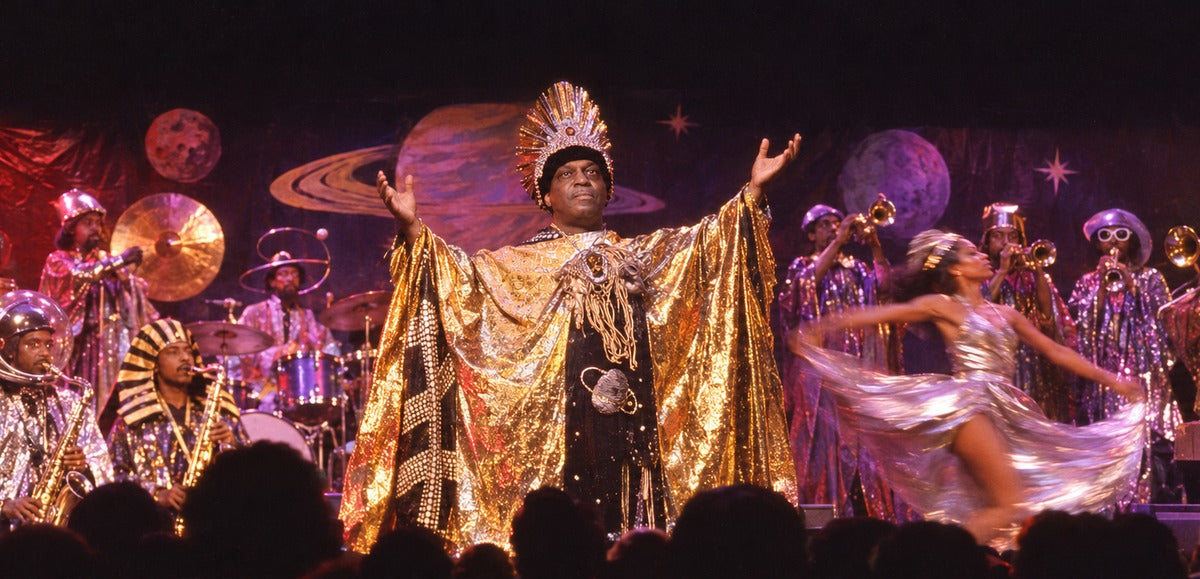

In the spring of 1971, a fifty-six-year-old bandleader stood at a chalkboard in a lecture hall at the University of California, Berkeley. He broke Bible verses, ancient Egyptian names and English slang into their syllables to show that the history taught in American schools was a deliberate distortion. His course, offered through the Afro-American Studies department, was called "The Black Man in the Cosmos." Students, Black Panthers and professors packed the room. Many came expecting theater. They got a rigorous lesson in how the human mind is conditioned, and how it can be freed.
Sun Ra spent his life teaching people to free their minds. The robes, the stagecraft and the story of Saturn carried a message about consciousness, the body, Black liberation and what a person can become. Born Herman Poole Blount in Birmingham, Alabama, in 1914, he looked at the narrow future Jim Crow America offered a Black man and built a complete philosophy to transcend it.
Deciphering the Code: Saturn as a State of Mind

His break with Earth came in Birmingham around 1936 or 1937, while he was studying music at Alabama A&M. As he later told it, a column of light surrounded him in his room. His body rose through the ceiling and traveled to Saturn, where beings with small antennas over their eyes told him the world was heading into chaos and that he would have to speak through music so people would listen. Then he was back in Alabama.
In Sun Ra's language, Earth stood for conditioned, limited consciousness: a mind trapped by history, habit and social programming. Saturn stood for higher consciousness, a vantage point outside the rules of a society that had written him off. To say he came from another world was to say that no one has to accept the mental boundaries of the time and place they were born into.
The language came from study. After he moved to Chicago in the mid-1940s, he spent years in public libraries and Black-owned bookstores reading Egyptology, the Bible, Theosophy, numerology and esoteric philosophy. He read Madame Blavatsky beside histories of ancient African civilizations and combed dictionaries for meanings hidden in everyday words. With his friend and business partner Alton Abraham, he printed broadsheets of his research, handed them out on the South Side, and stood in Washington Park debating history and theology with anyone who would stop.
He called this work myth-science, a disciplined way to reprogram the mind, and he built the Arkestra to deliver it. After arranging for the swing bandleader Fletcher Henderson in 1946 and 1947, he joined big-band craft to monastic rigor. He banned drugs and alcohol while addiction was devastating jazz. He demanded hours of daily rehearsal and sometimes woke his musicians at night to learn a new chart. Saxophonists John Gilmore, Marshall Allen and Pat Patrick and the singer June Tyson were students in a lifelong school, lifted out of the nightclub grind and trained to play anything from crisp swing to fearless free improvisation.
What Space Is the Place Was Teaching

His code is clearest in his 1974 film, Space Is the Place, directed by John Coney and shot in Oakland. On the surface it is a low-budget science-fiction movie. Underneath, it is an urgent lesson in Black liberation and self-determination.
Sun Ra lands in Oakland in a spaceship. He has found a new planet where Black people can live free, and he means to carry them there on the vibrations of his music. Against him stands the Overseer, a sharply dressed power broker who keeps Black Americans trapped in the existing system. The two play a cosmic card game for the fate of a people. The Overseer offers the street's familiar illusions: money, status, distraction. Sun Ra offers something harder, the courage to leave a broken world behind.
He opens the Outer Space Employment Agency. People walk in expecting a job and are asked whether they will leave Earth altogether. In a country that channeled Black workers into dead-end labor, he was asking why anyone should keep applying for a better seat inside a system built to keep them small.
The heart of the film comes at a youth center, where young Black people test whether his story is real. He turns the question back on them: are they real, in a society that treats them as invisible, erases their history and writes them out of the future? He is waking his students to their own condition. Liberation, the film says, cannot wait for permission from the institutions that created the problem. It begins when we reject the story we were handed and claim the right to write our own.
Politics Without Permission

Sun Ra's politics were practical and wholly his own. Through the Civil Rights and Black Power years he did not endorse politicians or trust earthly revolutions. To demand inclusion in a flawed system, he believed, was to accept its terms. He sought liberation through myth, self-reliance and a flat refusal of the identity America assigned to Black men.
In 1952 he legally changed his name to Le Sony'r Ra. Decades before the critic Mark Dery coined the word Afrofuturism in 1993, Sun Ra was building it. The science fiction of his day pictured an almost entirely white future; he answered by joining the ancient greatness of Egypt to the far reaches of space, with Black people at the center of both. He was among the first jazz musicians to bring the electric piano, the Minimoog and tape echo onto the bandstand, a sign that the future belonged to him and his community.
He backed the philosophy with practice. After moving the Arkestra from Chicago to New York in 1961, he settled it in 1968 in a row house at 5626 Morton Street in Philadelphia. The house was home, rehearsal hall and headquarters of El Saturn Records, one of the first musician-owned labels in jazz. The band pressed its own records, hand-painted its own covers, cooked its own meals and rehearsed under one roof. In an industry that stripped Black musicians of their royalties, he built an institution that answered to no one.
The Body, Desire, and the Discipline of Silence

His code reached the body as well. For most of his adult life he was celibate, slept a few hours a night and kept a wall of privacy that even his closest bandmates could not cross. Pressed about romance or sex, he answered in code, calling himself an angel or an alien, a being outside earthly biology.
His biographer John Szwed, in Space Is the Place: The Lives and Times of Sun Ra, finds little on record. There are no confirmed partners, no love letters, no confessions. Some who knew him wondered whether he was gay or asexual; others saw his celibacy as spiritual discipline, a way to keep his energy undivided.
What is clear is what the silence meant. In a society that policed Black men and reduced them to their bodies, Sun Ra made his body and his inner life sovereign. His silence was a discipline: no one outside would define his desires or hold leverage over his mind.
The Measure of Human Potential
In 1971, the year of the Berkeley lectures, he took the Arkestra to Egypt and played in the shadow of the Great Pyramid at Giza. It was the fulfillment of a lifetime spent insisting that Black history was ancient, vast and unbroken.
He died in 1993 in Birmingham, the city where Herman Blount was born. The Arkestra still tours, led for decades by Marshall Allen, still playing his charts and keeping his discipline.
Decades after his death, his work stands as a monument to human potential. He took a life that his era intended to keep small and turned it into a beacon for generations of artists, thinkers and listeners. He proved that a human being is not trapped by the ceiling the world builds over them. Through relentless study, daily discipline and an unbreakable inner code, he showed that consciousness can be expanded, history can be reclaimed, and a person can build a future even when the world refuses to hand them one.
Leave a comment
Comments will be approved before showing up.
Also in Sacred Surreal Blog





Cart (0)
Your Cart is Empty
Continue Shopping